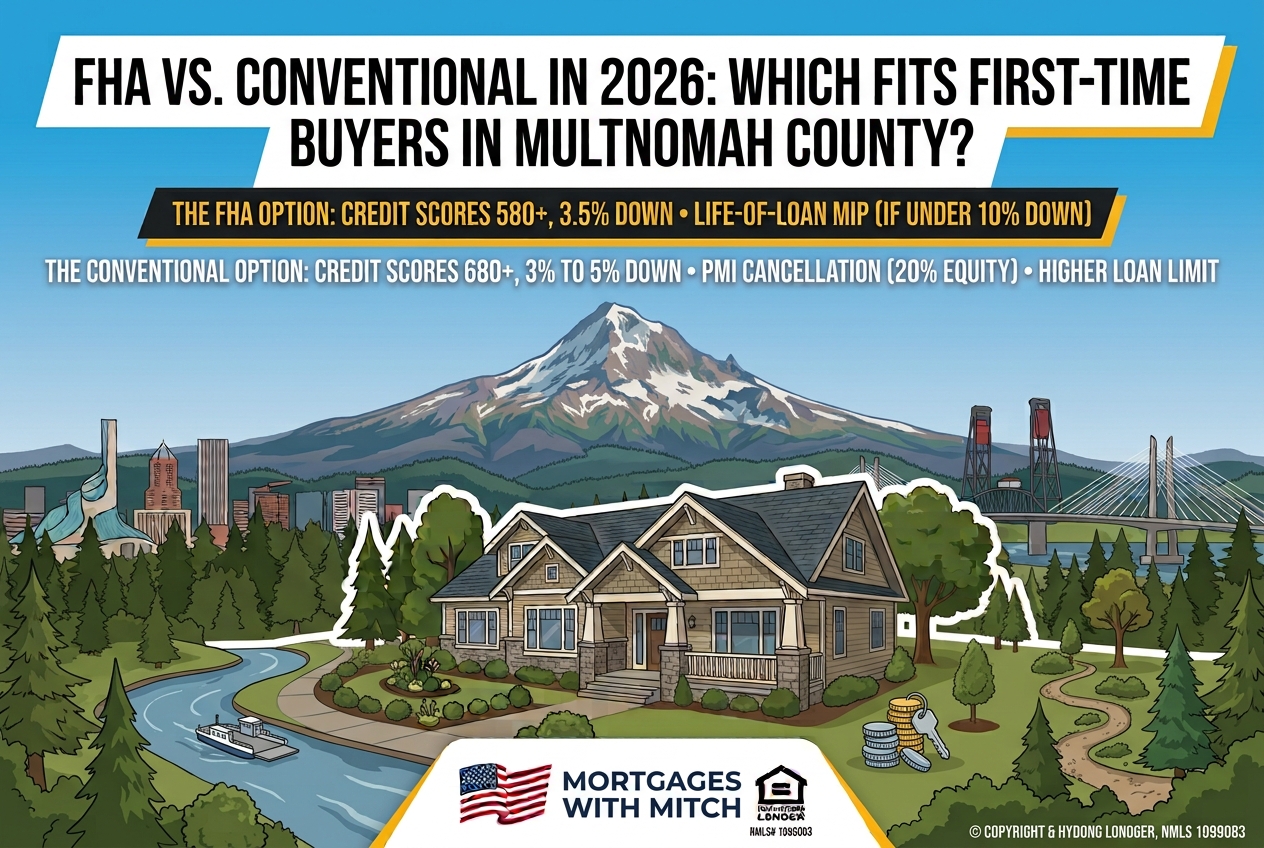
FHA vs. Conventional in 2026: Which Fits First-Time Buyers in Multnomah County?
FHA vs. Conventional in 2026: Which Fits First-Time Buyers in Multnomah County?
Quick answer: For most first-time buyers in Multnomah County, FHA works better with a credit score under 680 or a down payment under 5 percent, since FHA only requires 580 for 3.5 percent down. Conventional works better once your score clears 680 to 700, since you avoid FHA's mortgage insurance premium (MIP), which lasts the life of the loan on any down payment under 10 percent, and you can drop PMI once you hit 20 percent equity. The 2026 Oregon conforming loan limit is $832,750, well above the FHA limit for Multnomah County, so conventional also gives you more room on a higher-priced Portland-area home.
Written by Mitch Tugaw, Mortgage Loan Officer, NMLS #1995083, Mortgages With Mitch, Powered By Barrett Financial LLC, serving the Portland, OR / Vancouver, WA metro.
The short version
Both loans get first-time buyers into a home with a small down payment. The real difference is what you pay for mortgage insurance and how long you're stuck paying it. Here's how they actually compare for a buyer purchasing in Multnomah County right now.
Down payment and credit score
FHA:
3.5 percent down with a credit score of 580 or higher
10 percent down with a credit score between 500 and 579
More forgiving overall, including with past credit issues, collections, or a thinner credit file
Conventional:
3 percent down for eligible first-time buyers through Fannie Mae HomeReady or Freddie Mac Home Possible (income limits apply, tied to area median income)
5 percent down for most other first-time buyers
Typically wants a credit score of 620 or higher to qualify at all, and the best pricing usually starts closer to 680 to 700
If your score is in the 580 to 640 range, FHA is usually the only realistic path. Above 700, conventional usually wins on cost.
Mortgage insurance: the part most people get wrong
This is where the two programs really split, and it's the detail generic national articles tend to gloss over.
FHA MIP: You pay an upfront premium of 1.75 percent of the loan amount (this can be rolled into the loan) plus an annual premium of about 0.55 percent, paid monthly. Here's the catch: if you put down less than 10 percent, that annual MIP lasts for the entire life of the loan. It does not go away when you hit 20 percent equity. Your only way out is refinancing into a conventional loan later. If you put down 10 percent or more, MIP cancels automatically after 11 years.
Conventional PMI: PMI is required any time you put down less than 20 percent, but it is temporary. You can request cancellation once your loan balance hits 80 percent of the home's original value, and it terminates automatically at 78 percent, assuming your payments are current. On a typical Portland-area loan, that can mean PMI disappears in well under ten years, sometimes faster if home values rise.
Important exception: what most generic articles miss
Most "FHA vs. conventional" posts treat this as purely a credit-score decision. In a market like Multnomah County, where home values are well above the national median, that's incomplete. A buyer with a 620 score and 3.5 percent down might save money on their FHA payment today, but if they stay in the home long term without refinancing, that life-of-loan MIP can add up to more than conventional PMI would have cost over the same years, simply because the loan amounts here are larger. The other detail generic content skips: HomeReady and Home Possible income limits are set relative to local area median income, so what qualifies a buyer in a lower-cost part of the country may not apply the same way in Multnomah County. This needs to be checked against your specific household income and the property's location, not assumed from a national average.
Loan limits
The 2026 conforming loan limit for all Oregon counties, including Multnomah, is $832,750. That's the ceiling for a conventional loan without moving into jumbo territory. FHA's loan limit for Multnomah County is lower (currently estimated in the low $700,000s, and should be confirmed against HUD's published 2026 schedule before you rely on it for a specific purchase price). If you're shopping above the FHA limit, conventional is your only option regardless of credit score.
My take
I run both scenarios side by side for every first-time buyer before we pick a direction, because the "cheaper" option on paper isn't always the cheaper option over the life of the loan. If your score is still building, FHA can be the right move to get you into a home now, with a clear plan to refinance out of MIP once your equity and credit catch up. If you're already in the high 600s or better, we usually run the numbers and find conventional saves you more over time. Either way, this isn't a decision to make from a generic online calculator. Reach out here and I'll run your actual numbers, both ways, before you commit to either program.
This article reflects information as of September 2026. Terms and eligibility change. Confirm current details with a licensed loan officer before making financial decisions.


