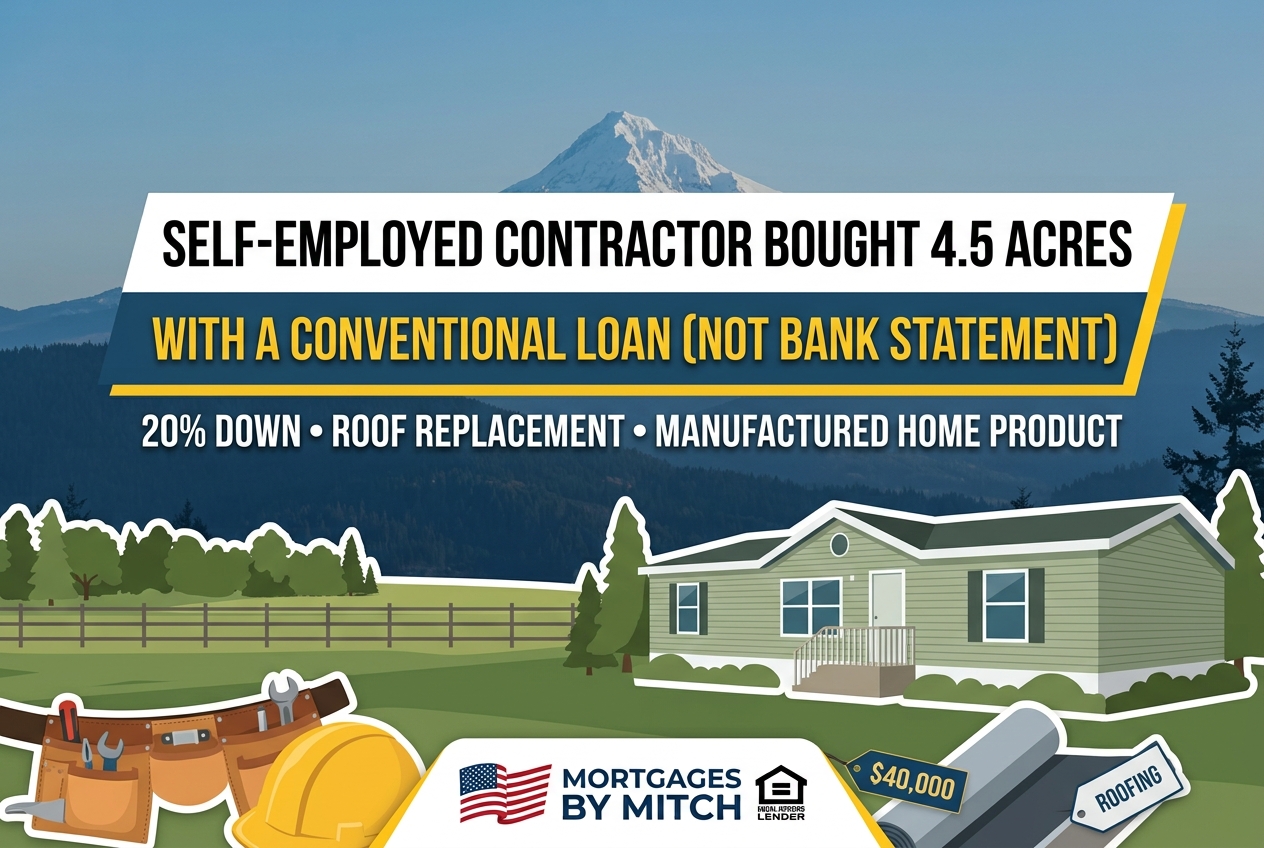
How a Self-Employed Contractor Bought 4.5 Acres Near Portland With a Conventional Loan
How a Self-Employed Contractor Bought 4.5 Acres Near Portland With a Conventional Loan (Not a Bank Statement Loan)
By Mitch Tugaw, Mortgage Broker, NMLS #1995083, Mortgages With Mitch, Powered By Barrett Financial LLC
Quick answer: A self-employed contractor came to me wanting to buy a home on land he could fix up. Being self-employed, he had two paths: a bank statement loan, which qualified him for a higher purchase price, or a conventional loan, which meant a lower payment and a lower rate. We ran the numbers on both and landed on conventional. He closed on a manufactured home on 4.5 acres just outside Portland, Oregon, with 20% down, after we worked through roughly $40,000 in required repairs mid-transaction, including a full roof replacement, and still secured him a very competitive rate on a manufactured home product.
If you're self-employed and assume a bank statement loan is your only option, or you're worried a fixer-upper on acreage is too complicated to finance, this story is for you.
The Situation: Self-Employed and Weighing Two Loan Paths
This buyer runs his own contracting business, so like most self-employed borrowers, his income doesn't show up as a clean W-2. That usually means one of two directions:
A bank statement loan, which qualifies income based on business or personal bank deposits instead of tax returns. It's often the go-to for self-employed buyers because it can qualify for a larger purchase price.
A conventional loan, which uses tax returns and standard income documentation and, when the numbers work, typically comes with a lower interest rate and lower monthly payment than a bank statement program.
We ran both scenarios side by side. The bank statement loan would have qualified him for more purchase price. But for the property and price point he actually wanted, the conventional loan meant a meaningfully lower payment and a better rate. Bigger approval isn't always the better deal, so we went conventional.
The Property: A Manufactured Home on 4.5 Acres
He found it just outside Portland, Oregon: a manufactured home set on 4.5 acres, with room to fix it up and settle his family into a piece of land rather than a standard subdivision lot. Manufactured homes on acreage are a great fit for buyers who want space and are willing to put in some sweat equity, but they also come with financing wrinkles that a lot of buyers (and even some loan officers) aren't ready for.
For context, the 2026 conforming loan limit across every county in Oregon, including Multnomah, Clackamas, and Washington counties, is $832,750 for a single-family home. Manufactured home financing works within that same conforming structure, but not every lender prices manufactured homes the same way, and rate spreads between lenders on this property type can be wide.
The Curveball: $40,000 in Repairs Mid-Transaction
Conventional loans already take a bit more upfront planning than some buyers expect. This deal added a real test: the appraisal came back subject to roughly $40,000 in required repairs before the loan could close, including a full roof replacement along with several other items.
That's the kind of thing that derails a closing if it isn't managed closely. It didn't here, because we stayed on top of it:
We got ahead of the appraisal conditions immediately instead of waiting to see if they'd go away.
We coordinated timing between the repair work, the contractor doing the repairs, and the closing date so one didn't stall the other.
We kept communication constant between the buyer, the seller's side, and underwriting so nobody was guessing about what was still outstanding.
Strong communication is what turned $40,000 in surprise repairs into a closed loan instead of a dead deal.
The Result: 20% Down and a Competitive Rate on a Manufactured Home Product
He closed with 20% down on the conventional loan. Because manufactured home rates vary more from lender to lender than standard site-built home rates, we shopped his file across our lending partners and found a lender with genuinely low rates on manufactured home products, not just an average rate padded for the property type.
He and his family now have 4.5 acres to build a life on, at a lower payment than the bank statement route would have given him, with the repairs already behind them instead of hanging over the first year of ownership.
What This Means If You're Self-Employed and House Hunting
More approval isn't always the better loan. A bank statement loan can qualify you for a bigger number, but that doesn't mean it's the right monthly payment for your goals. It's worth having both scenarios run before you decide.
Manufactured homes and land can absolutely be financed conventionally. It takes a lender who prices these products well and a broker who shops around, but it's a real, financeable path, not a niche workaround.
Repair conditions aren't a reason to panic. Appraisal-required repairs, even five-figure ones, are common on older or rural properties. What matters is having a plan and a team that keeps the timeline moving.
My take: This is exactly the kind of deal I like taking on: self-employed income, a property that isn't cookie-cutter, and a mid-transaction curveball. If you're self-employed and think your options are limited to a bank statement loan, or you're eyeing a fixer-upper on land and assuming it's too complicated to finance, let's talk through your specific numbers before you rule anything out. Reach out here.
Frequently Asked Questions
Can a self-employed borrower get a conventional loan instead of a bank statement loan? Yes. Self-employed borrowers can qualify for a conventional loan using tax returns and standard income documentation. It's worth comparing both a conventional and a bank statement scenario, since conventional often comes with a lower rate and payment, even if the qualifying income amount is smaller.
Can you get a conventional loan on a manufactured home? Yes, manufactured homes can qualify for conventional financing, though not every lender prices these loans the same way. Rate spreads between lenders on manufactured home products can be significant, so shopping the loan matters more than it does on a standard site-built home.
What happens if an appraisal requires repairs before a home can close? If an appraiser flags required repairs, most conventional loans need those items completed (or in some cases escrowed for) before closing. This is common on older homes, rural properties, and manufactured homes, and it's manageable with early coordination between the buyer, contractor, and lender.
Is a bank statement loan or a conventional loan better for self-employed buyers? It depends on the goal. A bank statement loan can qualify a self-employed borrower for a higher purchase price using bank deposits instead of tax returns. A conventional loan usually offers a lower rate and payment when the borrower's documented income supports it. The right answer comes down to running both options against the actual property and price point.
Have a Mortgage Question?
If you're self-employed, looking at a manufactured home, or just want a second opinion on your financing options before you make an offer, reach out directly. Client details are shared with permission and general enough to protect privacy.


